Paint Room Escape – Colorful Clues in a Locked Room 🎨🔐
Imagine being locked in a small, quiet room where your only hope of escape is… paint. Not brute force, not hidden keys in obvious places, but colors, brushes, and your own ability to notice tiny details. That’s exactly the kind of playful tension that Paint Room Escape delivers: a compact, clever escape room experience where creativity and logic collide.
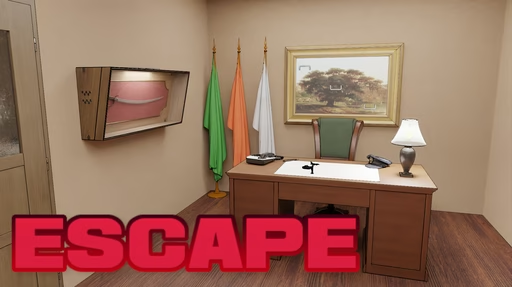
You wake up in a simple space: four walls, a desk, a shelf, an air conditioner, a safe, and a stubbornly locked door. At first glance, it looks minimal. But as you explore, you realize the room is filled with subtle hints, color-based puzzles, and tools that slowly transform the place into your own abstract canvas. Each clue leads to another, until the final lock clicks and you walk out… if you’re smart enough to get that far. 😉
What Is Paint Room Escape?
Paint Room Escape is a puzzle escape game centered around a single, self-contained room. Unlike horror escape rooms that rely on jump scares, this game focuses on:
-
Visual observation – paying attention to colors, shapes, and patterns.
-
Logical thinking – connecting clues in a step-by-step way.
-
Creative problem-solving – using paints and tools in unexpected combinations.
Instead of rummaging through dozens of rooms or large maps, you’re given one detailed space and asked to wring every secret out of it. The result is a focused, satisfying challenge that feels more like solving a clever brainteaser than wandering endlessly.
You’re not just looking for keys. You’re reading the room: the way objects are arranged, the order of colors on a shelf, the relationship between a painting and a lock pattern, maybe even the way the air conditioner display glows. Everything can matter.
Core Gameplay: How Paint Room Escape Works 🧩
At its heart, Paint Room Escape uses classic point-and-click escape room mechanics with an artistic twist:
1. Explore the Room
You’ll move your view around four walls, tapping or clicking on hotspots:
-
Desk – drawers, notes, brushes, paint tubes, maybe a palette.
-
Shelf – paint cans, books, decorative items, or mysterious color codes.
-
Air conditioner – temperature or mode indicators that might hide a clue.
-
Safe – a locked device that probably needs a code, pattern, or color sequence.
-
Door – your final goal, typically sealed behind one last puzzle.
Every object might hide another interaction layer: a drawer inside a desk, a paint tin with a label, a note with colored symbols, etc.
2. Collect and Use Items
As you click around, you’ll pick up:
-
Paint-related items (brushes, rollers, palettes)
-
Color samples or swatches
-
Notes and scraps with hints
-
Tools that let you interact with other parts of the room
Items often combine logically. Maybe you:
-
Use a brush with a specific paint color to reveal a hidden symbol.
-
Paint an object in a specific order to mirror a pattern seen elsewhere.
-
Mark something on the wall to match a clue from the shelf.
The game rewards curiosity. Try using items in different places and observe carefully when something changes.
3. Crack Color-Based Puzzles 🎨
The unique flavor of Paint Room Escape is its emphasis on color puzzles. Instead of only number locks or word riddles, you’ll often need to:
-
Match color sequences (e.g., red–yellow–blue–green).
-
Interpret color codes on notes and translate them into numbers or positions.
-
Mix colors logically (blue + yellow = green) and apply that logic to a puzzle.
-
Notice when one color appears in multiple places and connect those clues.
This makes the game feel like a mix of painting and code-breaking. It’s especially satisfying when you realize a random red smudge or a small colored square was important all along.
4. Chain Clues to Reach the Exit
Paint Room Escape is structured like a chain:
-
A small clue opens a drawer.
-
The drawer contains a tool or note.
-
That tool reveals a hidden symbol.
-
The symbol helps unlock the safe.
-
The safe contains a key or another vital clue.
-
Eventually, you confront the final lock on the door and walk out.
You’re constantly asking: “What did I just learn, and where can I use it?” That loop is what makes escape room games so addictive.
Why Paint Room Escape Is So Engaging 🎭
Even though everything happens in one room, Paint Room Escape feels surprisingly rich because it:
-
Respects your intelligence – puzzles are fair, and solutions make sense once discovered.
-
Feels tactile – using paint, brushes, and tools gives a sense of hands-on creativity.
-
Offers a calm but tense atmosphere – there’s no time pressure, but the locked door is always there, reminding you of your goal.
-
Appeals to both puzzle fans and art lovers – if you like patterns, colors, or design, many clues will feel especially satisfying.
It’s the kind of game you might sit down to “just try for five minutes,” only to realize half an hour flew by while you chased one clue after another.
Tips and Strategies to Escape Faster 💡
Want to get out of the paint room without getting stuck for ages? Here are some practical, spoiler-free tips:
1. Explore Systematically
Instead of clicking randomly, scan the room in a clockwise or counterclockwise order:
-
Check each wall.
-
Inspect the desk, shelf, air conditioner, safe, and door one by one.
-
Click on edges, corners, and small details that might hide hotspots.
This helps you avoid missing tiny clues, like a small smudge of color or a note pinned in the corner.
2. Keep Track of Color Patterns
Because color is the heart of the game:
-
Write down sequences (e.g., 🔴🟡🔵🟢) as you find them.
-
Note where you saw each combination (shelf, wall, safe, etc.).
-
If something looks like random decoration, assume it might be important later.
Sometimes a pattern makes no sense until you discover the lock it belongs to.
3. Try Using Items in “Unusual” Places
Many players get stuck because they only use tools where they expect them to work. In Paint Room Escape:
-
Try painting surfaces that seem ordinary.
-
Use tools on objects even if they don’t look obviously interactive.
-
Revisit earlier locations after you gain a new item.
The game rewards those little “What if…?” experiments.
4. Look for Relationships Between Objects
If you see a colored note near the shelf and a strangely colored marking near the safe, ask yourself:
-
Do these colors match in order or quantity?
-
Could one location be “telling” you how to interact with another?
-
Is there a symbol that appears in more than one place?
Escape room games often hide connections in plain sight, and this one is no exception.
5. Don’t Be Afraid to Step Away
If a puzzle has you stuck:
-
Take a short break 👣
-
Come back with fresh eyes.
-
Re-check the objects you think you “understand.” You might have missed a second layer.
Often, the solution is something simple that your brain just glossed over the first time.
Who Will Love Paint Room Escape?
This game is a great fit if you:
-
Enjoy escape room games and want a smaller, focused experience.
-
Like color puzzles, visual riddles, or art-inspired challenges.
-
Prefer thinking-based gameplay over reflex or action-based games.
-
Want a short, satisfying challenge rather than a huge, time-consuming campaign.
It’s also ideal for players who enjoy solving puzzles on their own, at their own pace, without feeling rushed. You can take your time, analyze each clue, and enjoy the satisfaction of cracking every lock.
Play Styles: Casual vs. Hardcore Puzzle Fans 🧠
Different players will approach Paint Room Escape differently:
-
Casual players might focus on exploring, clicking everything, and solving puzzles through trial and error. They’ll enjoy the cozy, experimental feel of painting and testing ideas.
-
Hardcore puzzle fans might bring a notebook, track every color code, and try to solve everything logically with minimal guessing.
The game supports both styles. You can either:
-
Glide through with a relaxed attitude and accept a bit of trial-and-error, or
-
Treat it like a serious brain workout and aim for a clean, efficient escape.
FAQ – Common Questions About Paint Room Escape ❓
Is Paint Room Escape difficult?
It’s challenging but fair. Most puzzles rely on observation and logic, not obscure trivia. If you pay attention to the room and think about how colors and patterns connect, you’ll make steady progress. Some moments might stump you for a bit, but that’s part of the fun.
How long does it take to beat the game?
It depends on your experience with puzzle and escape games:
-
New players might take 30–60 minutes to fully escape.
-
Experienced puzzle fans might finish faster, especially if they’re used to color codes and pattern-based locks.
Because it takes place in a single room, the pacing is tight and focused.
Are there jump scares or horror elements?
No, Paint Room Escape is based on puzzles and creativity, not horror. The tension comes from solving riddles and unlocking the door, not from scary imagery or sudden loud noises. It’s suitable for players who enjoy calm thinking games.
Do I need to know art or color theory?
You don’t need formal art knowledge, but basic color mixing ideas can help. For example, understanding that:
-
Blue + yellow = green
-
Red + blue = purple
can make certain puzzles more intuitive. But even if you don’t think of yourself as “artistic,” the clues are designed to guide you through the logic.
Is it better to play on a larger screen?
A larger screen (like a tablet or monitor) can make small details easier to spot, especially tiny symbols or subtle color differences. However, as long as you can see the room clearly and tap/click accurately, you can enjoy Paint Room Escape on many devices.
What should I do if I get stuck?
If you’re stuck:
-
Re-check every part of the room.
-
Look for objects you picked up but haven’t used yet.
-
Re-examine color combinations and patterns.
-
Ask yourself: “What changed recently?” after your last success.
Often, the next step is linked to the most recent thing you interacted with.
Final Thoughts: A Clever Little Escape Room with a Colorful Personality 🌈
Paint Room Escape proves that you don’t need a huge world or complex story to create an engaging puzzle experience. With just one room, a locked door, a safe, a few everyday objects, and a lot of clever color-based clues, it crafts a satisfying journey from confusion to clarity.
If you love:
-
Piecing together clues at your own pace,
-
Using paint and tools in imaginative ways,
-
And feeling that rush when the final lock clicks open,
then this game belongs on your must-play list. 🎉
Step into the room, pick up your brush, and let your creativity guide you to freedom. Every wall hides a hint, every color tells a story, and the exit is waiting for the player who can see the patterns hidden in plain sight.









Comments